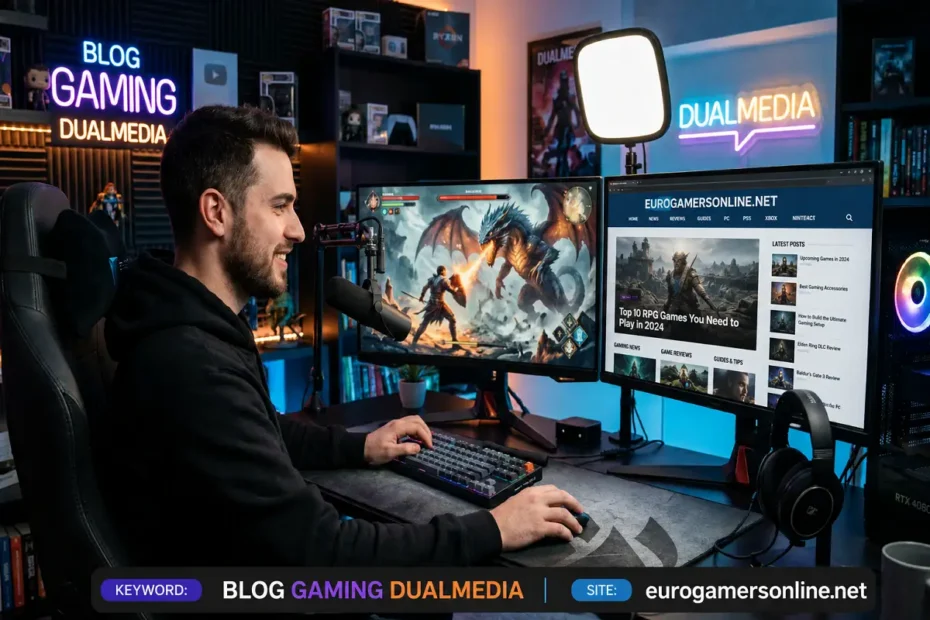
If you have searched for “Blog Gaming DualMedia” recently, you have probably noticed two things. First, the phrase appears across dozens of blogs that describe it slightly differently. Second, almost none of them clearly distinguish between the concept and the brand behind the name. This guide does. Blog Gaming DualMedia refers to two related but distinct things: a content format that pairs written blogging with interactive multimedia gaming elements, and an editorial property operated by DualMedia, a Paris-based digital innovation and esports group. Understanding both is essential if you are deciding whether to adopt the format, follow the publication, or evaluate it as a creator strategy. This article explains what the format actually is, where it came from, what it looks like in practice, and what working creators should know before committing time and budget to it.
What Blog Gaming DualMedia Actually Means
The term “DualMedia” describes content that operates on two channels simultaneously: traditional written blog content paired with a second layer of interactive or visual media, embedded gameplay video, livestream clips, polls, branching paths, podcasts, infographics, or short-form social formats.
The defining feature is integration, not addition. A standard blog with a YouTube embed at the bottom is not DualMedia content. A blog where the written analysis, the gameplay clip, the reader poll, and the comment-driven discussion are designed to work as a single experience.
In practical terms, a Blog Gaming DualMedia article on a new RPG release might combine a written review of mechanics and pacing, a 90-second embedded clip showing a specific combat encounter, a poll asking readers which class they chose, and a comment thread where the writer responds in near real-time. Each element does work; the others cannot.
The Two Meanings You Will Encounter
When researching this topic, you will see the phrase used in two ways:
- As a content format, a hybrid blog-and-multimedia approach that any gaming creator can adopt.
- As a publication, Blog Gaming DualMedia is also the name of an editorial hub from DualMedia, the French digital innovation company that also runs DualMedia Esports. The publication focuses on competitive gameplay intelligence, creator operations, and practical settings and templates for streamers and teams.
Most articles ranking for this keyword conflate the two. They are related, the format is what the publication produces, but searchers asking “what is Blog Gaming DualMedia” deserve to know which one they have found.
Why the Format Emerged
Gaming content evolved through three rough phases. Early gaming coverage in the 1990s and 2000s was almost entirely text: written reviews, forum posts, and walkthroughs in print magazines. The video era began with YouTube and Twitch, when Let’s Plays and livestreams pulled audiences toward visual formats. From around 2020 onward, audiences began wanting both at once: the depth and searchability of writing, and the immediacy and proof of video.
DualMedia content is the practical answer to that demand. Written articles still dominate Google search results for evergreen queries like “best builds in [game]” or “how to beat [boss],” while video dominates discovery on TikTok, YouTube Shorts, and Twitch. A single piece of content built across both formats covers both surfaces.
There is also a behavioral reason. Casual gamers spend roughly 13 hours a week engaging with gaming content across formats, and few stay loyal to a single medium. The same person reads a written guide on a desktop, watches a clip on their phone during a commute, and listens to a podcast while playing. Content built for only one of those moments loses the other two.
How a Blog Gaming DualMedia Piece Is Built
A well-constructed DualMedia article generally follows the same skeleton, regardless of game or topic.
The Hook and Written Core
The piece opens with a clear written angle, a thesis, a problem, or a question. This is what makes the content searchable and what gives it depth that a video alone cannot match. Strong DualMedia writing is concise, opinionated, and specific. Vague summaries do not survive the format because the embedded video will immediately expose any gap between claim and reality.
The Visual Proof Layer
Embedded clips, GIFs, or screenshots sit next to the claims they support. If the writer says a particular weapon feels sluggish, a 10-second clip shows the animation. If a strategy guide describes a flanking route, a short video walks it. The visual layer is evidence, not decoration.
The Interactive Layer
Polls, comment prompts, choice points, or simple embedded mini-games turn readers into participants. This is the element most often skipped and the one that most clearly separates DualMedia from a standard blog with embedded media. Done well, it raises time on page and gives the writer a direct signal about what readers actually care about.
The Cross-Platform Tail
The article does not end on the page. Clips are repackaged for Shorts and Reels, key claims become tweet threads, and the comment section feeds the next article. The blog post is the anchor; the rest of the ecosystem amplifies it.
Honest Tradeoffs Creators Should Weigh
Most articles on this topic read like sales pitches. They are not wrong about the upside, but they consistently underplay the cost. Here is the balanced view.
What the Format Genuinely Does Well
Engagement metrics tend to improve. Time on page rises when video and interactivity are integrated rather than tacked on. Search visibility benefits from the text layer, while social discovery benefits from the video layer; a combination of single-format content cannot match. Monetization options widen because the same piece supports display ads, sponsored video segments, affiliate links in writing, and paid newsletter or community tiers.
What It Costs
Production time roughly doubles or triples compared to a written-only post. A serviceable DualMedia article requires writing, recording, editing, thumbnail design, and community moderation. Solo creators feel this costs the most. The format also rewards consistency: an article published once and abandoned underperforms a written-only post, because the interactive layer dies without active engagement. And SEO upside is real but slow, interactive elements help retention signals, but Google still ranks pages primarily on the strength of the underlying writing and the site’s overall authority.
Who Should Actually Adopt It
DualMedia is a strong fit for creators who already produce video, for esports teams and orgs with footage assets, and for established gaming sites looking to defend against pure-video competitors. It is a poor fit for very new blogs without an audience to interact with, or for writers who do not enjoy or have the resources for video production. Adding a YouTube embed to a written post is fine and useful, but it is not the same thing as DualMedia, and pretending otherwise wastes effort.
Practical Steps If You Want to Try the Format
For creators considering this approach, a realistic starting sequence looks like this. Pick one game or sub-niche narrow enough to cover deeply. Build a content template that pairs each written piece with at least one short clip and one interactive element; a poll is the lowest-cost option. Use lightweight tools: OBS for capture, CapCut or DaVinci Resolve for editing, a WordPress poll plugin or a native platform poll for interactivity. Publish on a cadence you can sustain for at least three months, because the format compounds and early pieces underperform later ones. Measure time on page, scroll depth, and comment volume, not just pageviews, because those are the metrics the format actually moves.
Frequently Asked Questions
Is Blog Gaming DualMedia a website or a content strategy?
Both. DualMedia, a Paris-based digital company, runs a publication, Blog Gaming DualMedia, focused on competitive gameplay and creator guidance. The same phrase is also used generically to describe the hybrid content format that combines blogging with interactive multimedia.
Do I need video skills to create DualMedia content?
You need basic competence with screen recording and editing, but not professional production skills. Tools like OBS Studio (free) and CapCut (free) cover most needs. Polished editing matters less than relevance; a 30-second clip showing exactly what your writing describes outperforms a polished but generic montage.
Does DualMedia content actually rank better on Google?
Not automatically. Google rewards content that satisfies search intent, and DualMedia formats can do that well because they keep readers on the page and let them verify claims visually. But the same SEO fundamentals still apply: clear writing, useful information, technical site health, and authority. Embedding videos in a thin article will not rank it.
Is this just a rebrand of “multimedia blogging”?
Largely, yes, with one meaningful difference. Multimedia blogging traditionally means a written post with media inserted into it. DualMedia, as the term is now used in gaming, implies the formats are designed together, with interactive elements and cross-platform distribution treated as part of the original piece rather than added afterward.
How is this different from a YouTube channel with a blog?
A YouTube channel with a companion blog typically treats each format as standalone. DualMedia treats them as one piece distributed in two layers. The written and video components reference each other, share a single thesis, and are usually published together rather than on separate schedules.
Can small creators compete using this format?
Yes, but selectively. A small creator covering one game deeply with consistent DualMedia output can outperform larger sites that publish broad, written-only content. The advantage comes from depth and specificity, not scale. New creators trying to cover everything in DualMedia format usually burn out before the strategy compounds.
The Bottom Line
Blog Gaming DualMedia is a useful term for a real shift in how gaming content works in 2026. The hybrid format genuinely improves engagement when executed well, and the publication of the same name produces some of the more practical creator-focused gaming content available. Neither is magic. The format costs more time than written-only blogging, the publication is one of many credible sources, and the SEO benefits depend on the same fundamentals that have always mattered: useful information, honest writing, and consistency.
If you take one thing from this guide, take this: DualMedia is a production discipline, not a content trick. Creators who treat it as the former build durable audiences. Those who treat it as the latter publish a few interactive posts and quietly return to standard blogging within a quarter.
For any suggestions or changes, please contact us.