
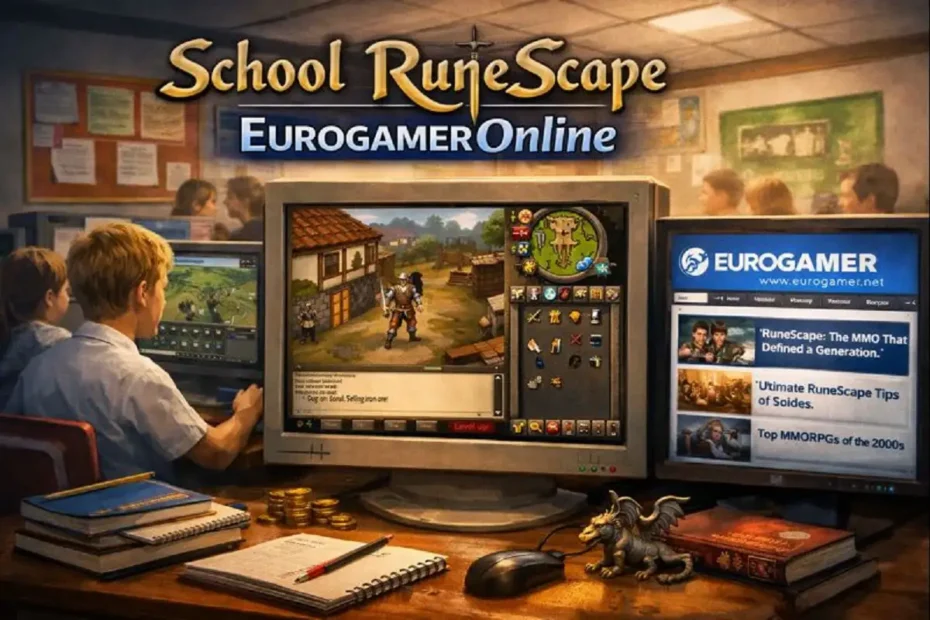
Old School RuneScape (OSRS) is not just a game; it is a phenomenon. Originally released by Jagex on 22 February 2013 as a faithful recreation of the 2007 version of RuneScape, it has since evolved into one of the most beloved MMORPGs in the world. Major gaming outlets, including Eurogamer, PC Gamer, and GamesRadar, have covered it extensively, and for good reason. OSRS broke all records in August 2025, reaching an all-time high of over 240,000 concurrent players, a staggering number for a game whose graphics some critics humorously describe as “potato quality.”
Whether you are a brand-new adventurer stepping off Tutorial Island for the first time or a veteran returning after a years-long break, this guide delivers the practical, expert-backed knowledge you need to thrive in Gielinor.
What Is Old School RuneScape and Why Does It Still Matter?
The Origins of a Gaming Legend
When Old School RuneScape launched, it began as an August 2007 version of the game RuneScape, which was hugely popular before the launch of RuneScape 3. What started as a nostalgic snapshot for veteran fans quickly became the dominant version of the game. The community rallied around it, and Jagex listened, updating and expanding it continuously through a democratic polling system that puts major content decisions in the hands of the players themselves.
It is a sandbox MMORPG that is deliberately grindy and intimidatingly hands-off. That is precisely the point. In an era of hand-holding open-world games and battle-pass fatigue, OSRS stands defiantly apart. You are dropped into the world of Gielinor and told, essentially, to figure it out. That challenge is not a flaw; it is the entire appeal.
How Eurogamer and the Gaming Press Have Covered OSRS
Old School RuneScape has been a recurring subject across the world’s top gaming publications. Writers from Eurogamer, PC Gamer, GamesRadar, and IGN have documented everything from its record-breaking player counts to its passionate, sometimes hilariously unhinged, community moments. PC Gamer summed it up perfectly: “Old School RuneScape is a massive but compelling time sink, and even after all these years, there’s simply nothing else like it.”
The game’s continued dominance in gaming press coverage is a testament to one thing: OSRS keeps generating stories because its players keep doing extraordinary things inside it.
Getting Started: Your First Hours in Gielinor
Completing Tutorial Island the Right Way
Every new player begins on Tutorial Island. This brief introductory area walks you through the absolute basics — movement, combat, skilling, and the game’s interface. Do not rush through it. Pay attention to the interface layout, particularly your Skills tab, Inventory, and the Quest list. These three panels will govern the majority of your time in OSRS.
Once you finish Tutorial Island, you are deposited in Lumbridge, a small, forgiving starting town. From here, the world is yours to explore. OSRS does not hold your hand. There are no quest markers, no recommended zones, and no automated skill paths. That freedom can feel overwhelming at first, but this guide will give you the structure that the game intentionally withholds.
The First Things Every New Player Should Do
Before you start grinding goblins, there are a few foundational steps that will save you hundreds of hours of frustration:
Set up account security immediately. Enable two-factor authentication right away. It is vital for security and also unlocks 10,000 coins and gear from the Stronghold of Security dungeon in Barbarian Village. That is free money and equipment just for protecting your account.
Head to the Grand Exchange as soon as possible. The Grand Exchange is the economic heart of Gielinor, where players from all worlds trade. Getting there early is a priority, as it turns your gathered resources into gold. Located northwest of Lumbridge in Varrock, it is your gateway to the game’s economy.
Download RuneLite. While the official client works perfectly well, the community-maintained RuneLite client offers plugins like a quest helper, ground item markers, and XP trackers that make the game significantly more approachable without breaking the spirit of the experience.
Skilling, Questing, and the Path to Progression
Understanding Skills in OSRS
Old School RuneScape is an MMORPG with adventure elements, primarily utilising point-and-click mechanics. It features 23 skills, each of which can be levelled from 1 to 99, with a maximum total level of 2,277. Skills fall into three broad categories: combat skills (Attack, Strength, Defence, Hitpoints, Prayer, Magic, Ranged), gathering skills (Mining, Fishing, Woodcutting, Hunter, Farming), and artisan skills (Smithing, Cooking, Crafting, Fletching, Herblore, Runecrafting, Construction).
There are many ways to train a skill in Old School RuneScape. The skill training guides mostly focus on methods that give a good amount of experience for the time invested (XP per hour). Early in the game, completing quests is often more efficient than alternative training methods.
For beginners, the recommended starting skills are:
- Combat – Train on Goblins and Cows east of Lumbridge early on, progressing to stronger enemies as your levels grow.
- Fishing and Cooking – Fishing is relaxed, consistent money, and a good food source, and Cooking levels up naturally alongside it.
- Woodcutting and Firemaking – An excellent AFK-friendly combination that builds two skills simultaneously with minimal attention.
Why Quests Are Your Best Friend
This is the most important piece of advice this guide can offer: do your quests. New players frequently make the mistake of grinding skills from level 1, unaware that quests offer enormous experience rewards that skip hours of low-level monotony.
Many early quests provide massive chunks of experience that skip hours of low-level grinding. Vampyre Slayer gets you to level 20, Attack instantly. The Knight’s Sword gets you to level 29 Smithing instantly.
Quests in Old School RuneScape are in a league of their own. Rather than being told to “kill 10 boars,” each quest is a narrative experience, and many of them offer powerful rewards or unlock brand-new content. Some quests unlock entirely new regions of the map, new bosses, and even new continents. The Children of the Sun quest, for example, unlocks the vast new continent of Varlamore, and it is completable very early in your journey.
The optimal quest guide on the OSRS Wiki lists quests in an order that allows new members to progress in a way that minimises the amount of skill training required. Bookmarking that page is strongly advised.
Membership, Free-to-Play, and What You Actually Get
Is the Membership Worth It?
Old School RuneScape is free to play, but the free version represents only a fraction of the full game. There are 21 free quests and 121 members’ quests. The gap in content between F2P and membership is vast: members gain access to dozens of additional skills (including Herblore, Agility, and Slayer), hundreds of quests, the majority of the game’s map, all bosses, and the Grand Exchange’s full trading potential.
Membership dramatically improves the early game. Free-to-play is fine to learn the basics, but progression, quests, bosses, skills, and money-making truly open up in Pay-to-Play. For anyone seriously considering the game, a membership subscription is a meaningful investment that unlocks the full depth of what OSRS has to offer.
Community, Culture, and Why OSRS Endures
One of Old School RuneScape’s greatest strengths is its community. It is famously devoted, frequently eccentric, and deeply passionate about the game’s integrity. Major decisions, including whether to add new skills, change existing mechanics, or introduce new content, are put to a community vote. This democratic system has shaped OSRS into exactly what its players want it to be, rather than what a corporate development roadmap dictates.
The game does not compete with massive AAA titles for the best graphics. It focuses on entertaining a simple package. That philosophy has kept it relevant for over a decade. When players say OSRS is their “forever game,” they mean it — and the numbers back it up.
Frequently Asked Questions:
Q: Is Old School RuneScape the same as RuneScape 3?
No. Old School RuneScape is a separate, standalone version of the game based on how RuneScape looked and played in 2007. RuneScape 3 is the modern, continuously updated main version of the game with significantly different graphics, mechanics, and content. Both are developed by Jagex, and both require separate accounts.
Q: Can I play Old School RuneScape on mobile?
Yes. A mobile version for Android and iOS was released in October 2018. The mobile client supports full cross-platform progression, meaning you can seamlessly switch between your PC and mobile device using the same account.
Q: Is Old School RuneScape free to play?
Yes, but with limitations. The free version provides access to a core portion of the game, including 21 quests and a limited set of skills and areas. A membership subscription unlocks the full game experience, including 121 additional quests, all skills, and the majority of the map and bosses.
Q: How do I make money early in OSRS?
Try to make money as early as possible so you can buy a Bond from the Grand Exchange without paying real money. Early money-making methods include selling cowhides, fishing and cooking food for sale, mining and selling ores, and completing quests that award gold or valuable items.
Q: What client should I use to play OSRS?
The official Jagex client works well, but most players recommend RuneLite, a free, open-source third-party client that Jagex officially endorses. It includes hundreds of quality-of-life plugins, including a quest helper, XP tracker, and loot logger.
Q: Is Old School RuneScape beginner-friendly?
It is not immediately beginner-friendly in the traditional sense. It is the kind of game where you have to bookmark the wiki before you can get anywhere. But if you are willing to push through the harsh learning curve, you may well find your forever game. Using a beginner roadmap, the OSRS Wiki, and the RuneLite quest helper plugin dramatically smooths the onboarding experience.
Q: Why do gaming outlets like Eurogamer keep covering OSRS?
Because the game and its community never stop generating remarkable stories. From record-breaking concurrent player counts to players spending thousands of hours on single self-imposed challenges, Old School RuneScape produces the kind of genuine human interest content that resonates far beyond its core audience.
Final Thoughts
Old School RuneScape is one of the most authentic gaming experiences available today. It demands your patience, rewards your curiosity, and punishes complacency, all in a package that looks like it was designed in 2001. That is not a criticism. It is the entire point.
Whether you discovered it through Eurogamer coverage, a recommendation from a friend, or a nostalgic itch you could not ignore, OSRS is a game that gives back in proportion to what you put in. Start with Tutorial Island. Do your quests. Head to the Grand Exchange. And bookmark the wiki. Everything else will follow.
For any suggestions or changes, please contact us.