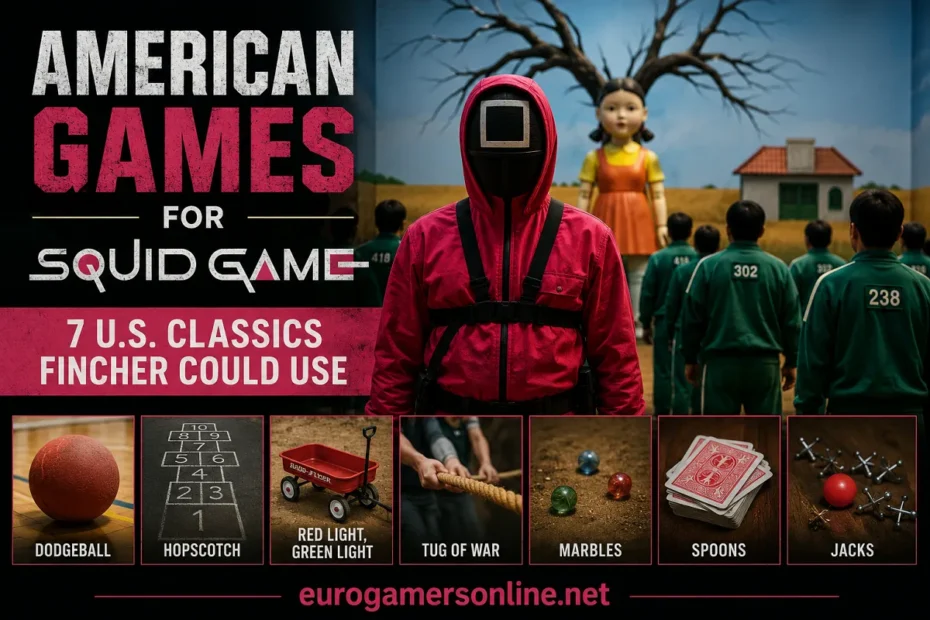
When Cate Blanchett appeared on a deserted Los Angeles street in the final scene of Squid Game Season 3 and invited a man to join the game with a Dadakji-style card, it became clear that these bloody competitions were now heading to America. Ever since news broke that principal photography for Squid Game: America will begin on February 26, 2026, in Los Angeles under the direction of acclaimed director David Fincher, the debate has shifted. The question is no longer whether an American version will be made, but rather which traditional American childhood games can evoke the same strong emotions as the original Korean series’ Red Light, Green Light, dalgona, and ddakji?
This article attempts to understand this question in detail, in light of information that has been officially released regarding the production, public statements from creator Hwang Dong-hyeok, and which popular American games actually have the strong structure that can help the show effectively present itself across cultures.
What We Actually Know About Squid Game: America
Before speculating about the games, it’s best to separate factual news from rumors. Here’s what’s officially out there, as of the end of 2025.
According to information listed by the Film and Television Industry Alliance, regular shooting for Squid Game: America is expected to begin on February 26, 2026, and Los Angeles and California have been selected as primary locations. The series is said to be written by Dennis Kelly, the creator of the popular Channel 4 show Utopia. The project is not a remake of the original story, but a new spin-off series based on the same universe, which will show how these games are played in America and how the system works there.
Hwang Dong-hyeok, the original creator of the popular series, has already made it clear that Netflix did not formally consult him on the spin-off project. However, he sees the idea of directors and writers from different countries creating new versions that are culturally appropriate. According to him, the original Korean story ended with Gi-hoon’s journey in season 3, and he personally has no plans to continue the series.
Cate Blanchett’s brief appearance in season 3 sparked speculation among fans, but reports suggest it was just a symbolic scene, not a sign that she’s set to be the main character in the spin-off. According to the latest information, her character will not appear in Squid Game: America.
With filming set to begin in February 2026 and Fincher’s slow and meticulous post-production, the series’s expected release could be in 2027 or 2028.
Why the Games Have to Change
The real power of Squid Game was not just in its dangerous scenes, but in the way it turned innocent childhood games into symbols of fear. Games like Red Light, Green Light, dalgona, ddakji, and gonggi are all things that Koreans associate with their childhood memories. When these simple games turned into death and danger, it deeply affected the emotions of the audience and evoked a certain ethnic and cultural feeling.
If the American version is to have the same impact, the games must have the same three key features that were the hallmarks of the original games.
The first condition is that the game must be played by almost everyone in childhood and be a familiar part of the culture. Even better, American children must have experienced playing it at school or in the park.
Another important aspect is that the rules of the game are simple and easy to understand, so that viewers who speak other languages can understand them immediately through subtitles. A viewer in a country like Brazil may not feel the need for any additional explanation to understand it.
The third element is a strong game rule that brings out unity, deception, or sacrifice when the pressure is on. The tug-of-war in the original Squid Game was not just for fun, as it required complete teamwork to win. Similarly, the game of marbles was designed for a specific purpose, where the rules forced friends to fight against each other.
With these points in mind, these American games can be the best choice.
The Strongest American Game Candidates
Red Rover
Red Rover is an American game considered very similar in structure to tug-of-war, and it also played a major role in the Korean original story. In it, two groups stand in a row facing each other and link their hands. Then one team calls out to a specific player: “Red Rover, Red Rover, send [player] over to us.” That player then charges the opposing team’s line with all his might to break the chain of hands. If he succeeds, he takes a player with him for his team, and if he fails, he becomes part of the opposing team.
Recreated with a dangerous ending, “Red Rover” takes on a very tough and ruthless game. Each team has to decide which players to field in their ranks, strong ones who can stop the attack or weak ones who can be sacrificed in case of defeat. This competition depends not only on strength, but also on intelligence, planning, and toughness of heart. That is why fans and critics often call it the best choice for a possible American version.
Simon Says
“Simon Says” can be considered a much simpler and more American-style alternative to “Red Light, Green Light.” It is a game familiar to almost everyone, with rules that can be explained in a few words, and it creates the same kind of tension and uncertainty as the original game: the silence during the pauses in the instructions, the pressure to react immediately, and the high cost of making a bad decision.
“Red Light, Green Light” was primarily a test of self-control and the ability to stop, while “Simon Says” is more of a test of attention, comprehension, and judgment. If a slightly creative twist were added, such as an AI-based authority figure who would issue instructions in a rapid and changing manner, it could become an intense, stressful, and confined game that Western audiences would immediately recognize and feel its tension.
Musical Chairs
Musical Chairs is a fairly straightforward and obvious concept in its symbolic nature. It can be seen as an example of the capitalist system: there are many people but limited seats, the music suddenly stops, and at that moment, a sense of anxiety and competition arises. This is exactly the kind of symbolic structure on which the original Squid Game story was built. Since the game is known to children in almost every part of the world, it is immediately and easily understood by a global audience.
Its visual presentation is also very likely. Imagine an environment that is completely simple, bright, and clean, where all the players are present in order and in formal attire, and as soon as the music stops, the chairs suddenly disappear into the floor. This whole scenario automatically creates the feeling of a complete story, as if each step itself is leading to the next turn.
Dodgeball
Dodgeball is considered the most physically demanding and demanding American sport on this list. It is not just a recreational activity but a part of American school culture, as most adults played it in the school gymnasium rather than on the playground or in the street, as children did. This particular fact gives it a kind of genuine documentary significance. It encapsulates memories of American childhood in the same way that “duckjie” represents Korean childhood.
The game also offers a solution to a major narrative and structural problem. The original series had a very deliberate and limited number of moments where players would end up together. Dodgeball fills this gap by providing a clear and structured structure in which a large number of players can be eliminated in a single round, while still maintaining the need for teamwork, strategy, and individual skill.
Capture the Flag
Capture the Flag could be a strong choice for a mid-game in the series, much like the original Marbles or Glass Bridge. It requires players to have a terrain, a plan, and teamwork, allowing the writers to create long scenes that involve alliances forming, breaking, and sudden changes. The game pits two teams against each other, each with a flag, a competition area in the middle, and a separate prison for the captured players. The entire structure of the game already forms a complete cinematic and visual experience.
Four Square
Foursquare is an unexpected but noteworthy choice. It’s a simple game, played in a small space, and doesn’t require any special equipment. One interesting thing about it is that its rules vary from region to region, reflecting the regional diversity and local flavor of American culture.
If it were presented as a showdown between the few remaining players at the end of the story, it could recreate the intimate, emotional, and tense atmosphere of the Season 1 episode “Marbles.”
Hide and Seek
This choice has the potential to create the most mental and psychological stress. Hide and Seek is a game that can be easily played with any number of players and seems to fit perfectly with Fincher’s unique visual style. It creates the slow-paced tension that is a hallmark of his work. It is also highly adaptable. Imagine if the seekers were armed, the playing field was extremely wide, and the rules changed slowly over time; the situation could become completely unpredictable and dangerous.
What to Expect (and What Not To)
A handful of practical expectations worth keeping in mind.
Fincher’s “Squid Game” will likely have a different feel than the original Korean version. His works, like Se7en, Zodiac, The Social Network, and Mindhunter, are generally known for their serious, deep, and methodical style, where the emphasis is on reality and detail rather than emotion. While the original series featured emotional engagement and dramatic intensity, Fincher’s style is usually toned down. As such, the new version is likely to create a colder, more controlled, and analytical atmosphere. Whether this change improves the series or takes away the human warmth that characterized the original is up for debate.
Its social aspect is also likely to take a new direction. The original drama consistently addressed the pressures of debt, class injustice, and modern capitalism in South Korean society. An American version would have to adapt to its own social realities: heavy student loans, a financial crisis linked to medical expenses, precarious and insecure gig work, and the socio-psychological complexities arising from the opioid crisis. Dennis Kelly’s previous works, particularly Utopia, indicate that he has the ability to dramatize such tough, dark, and complex social issues.
It should be clear that there is no official confirmation at any level regarding the games that will be featured in the spin-off. The games mentioned in this article are not definitive information, but rather based on guesses and speculation, derived from the original series’ narrative structure, combined with reviews from viewers and critics, and available informal reports about the project.
Until final details about casting and game design are revealed or leaked, and given Netflix’s strict secrecy, these things usually only come out closer to release. All information beyond the production schedule should be considered tentative and uncertain.
Final Words
The games that could be used as a basis for Squid Game: America in the United States are not necessarily the most terrifying or visually impressive. The real criterion is which games hold the same place in American culture as games like “Red Light, Green Light” and “ddakji” do in Korea, simple and common childhood games that most Americans have played, with simple rules but with an inherent sense of competition and drama. From this perspective, Red Rover, Simon Says, Musical Chairs, Dodgeball,l and Capture the Flag seem like the strongest candidates, and they could be effective story material for any writer.
The real issue is not the choice of games. The more important question is whether the creators can portray class inequality and economic oppression in America in the same way that Hwang Dong-hyuk portrayed social conditions in Korea, ea that is, by turning innocent childhood activities into a mirror that exposes society’s treatment of the weak and the losers. The games are just an external structure, while the real meaning is the social message hidden behind them. Until casting, story details, and game design are clarified closer to a potential 2027–2028 release, the real focus should remain on this core idea.
Frequently Asked Questions
When does Squid Game: America come out?
No official release date has been announced for the project yet. According to available production information, filming is expected to begin in Los Angeles on February 26, 2026. Given Fincher’s usual lengthy post-production phase, it is likely that the project could be released during 2027 or 2028.
Is Squid Game: America a remake or a spin-off?
It is a spin-off. According to available production listings and subsequent reports, the series is set in the same fictional universe as the original Korean show, but features entirely new characters and a fresh storyline. The goal is not to retell GI Hun’s story, but to present a new narrative in a new direction.
Who is directing Squid Game: America?
David Fincher, who has directed such acclaimed works as Se7en, Fight Club, The Social Network, and Mindhunter, is attached to direct the project. Dennis Kelly, best known as the creator of the Channel 4 drama Utopia, is reportedly writing the script for the project.
Is Cate Blanchett in Squid Game: America?
Despite her brief appearance in the Season 3 finale, several reports indicate that Blanchett will not be joining the spinoff. It is now being seen more as a symbolic gesture that signals the expansion of the franchise, rather than the start of a new or ongoing story for her character.
Is Squid Game: The Challenge the same as Squid Game: America?
No, Squid Game: The Challenge is a reality competition that involves no physical harm, and it has been airing on Netflix since 2023. The program features 456 real people competing against each other for a grand prize of $4.56 million. Squid Game: America, on the other hand, is a completely different project, being developed as a scripted drama and is still in the early development stages.
Did the original creator approve the American version?
HwanDong-hyukuk has clearly stated that he was not formally consulted regarding this project, but he is in favor of creators from different countries creating local versions according to their cultures. He has also stated that after Season 3, he does not intend to continue the Korean story of “Squid Game” and that its main story will be fully realized there.
Which American games are most likely to appear?
No games have been officially confirmed yet. Given the structure of the original series, the worldwide recognition of these games, the simple and straightforward rules, and the strong dramatic impact, the most likely choices would be: Red Rover, Simon Says, Musical Chairs, Dodgeball, and Capture the Flag.
For any suggestions or changes, please contact us.