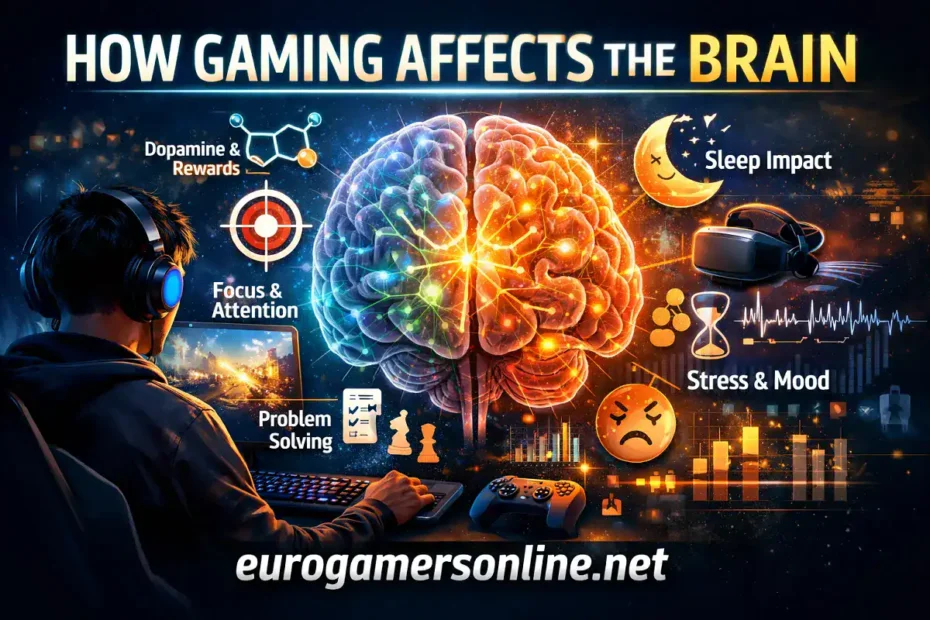
Video games are more than just entertainment; they are immersive cognitive environments that actively engage the brain’s reward systems, attention networks, executive functions, stress responses, and social circuits all at once. Because gaming combines rapid feedback, goal pursuit, competition, problem-solving, and social interaction, it can sharpen certain mental skills, such as reaction time, visual attention, and strategic thinking. Still, it can also disrupt sleep, increase arousal, and become compulsive when played without boundaries. The real impact of gaming on the brain isn’t simply “good” or “bad”; it depends on how long you play, when you play, what types of games you choose, and how well gaming fits into your overall lifestyle. In this comprehensive guide, we’ll break down exactly how gaming affects the brain, what the science actually says about its benefits and risks, and how to structure your gaming habits so they support, rather than undermine, your cognitive health.
What Happens in the Brain During Gaming
Video games activate multiple neural systems simultaneously. Understanding these systems explains both the benefits and risks.
1. Reward System & Dopamine: Why Games Feel Compelling
Video games are built around structured reward loops:
-
Goal
-
Effort
-
Feedback
-
Reward
These loops activate the brain’s reward learning system, often associated with dopamine signaling. Dopamine is not simply a “pleasure chemical”; it helps the brain learn which behaviors are worth repeating.
Why This Matters
When rewards are:
-
Frequent
-
Variable (unpredictable)
-
Linked to progress (levels, loot, ranks)
The brain strengthens motivation pathways around the game.
This is useful for:
-
Skill development
-
Habit formation
-
Learning complex systems
But excessive exposure to high-frequency reward loops can create:
-
Strong cravings to continue playing
-
Difficulty stopping
-
Preference for gaming over slower real-world rewards
Key Insight: If gaming feels like something that “pulls” you rather than something you consciously choose, reward loops may be too strong.
2. Attention & Perceptual Processing
Fast-paced action games require players to:
-
Track multiple objects
-
Filter distractions
-
Make rapid decisions
-
Detect visual changes quickly
Research reviews suggest improvements in:
-
Selective attention
-
Visual processing speed
-
Reaction time
-
Some visuospatial abilities
However, improvements typically show near transfer, meaning gains apply most strongly to similar tasks, not general intelligence.
Important: High-arousal games increase alertness. Playing them late at night can impair sleep onset.
3. Executive Function & Self-Control
The prefrontal cortex supports:
-
Decision-making
-
Inhibition
-
Planning
-
Emotional regulation
Gaming engages these systems, especially in strategy games, puzzles, and team-based competitive environments.
However, highly arousing or competitive gaming can temporarily:
-
Increase emotional reactivity
-
Reduce impulse control (short-term)
-
Increase irritability after losses
This is especially relevant in youth and during sleep deprivation.
Translation: Competitive ranked modes behave more like sports competitions than passive entertainment.
4. Stress & Physiological Arousal
Competitive and high-stakes gaming can elevate physiological arousal:
-
Increased heart rate
-
Heightened alertness
-
Stress-like activation
This is not inherently harmful; it resembles athletic competition, but repeated high-arousal sessions without recovery can lead to:
-
Irritability
-
Mental fatigue
-
Sleep disruption
Recovery strategies matter.
The Cognitive Benefits of Gaming (Realistic Expectations)
Research syntheses commonly report improvements in certain domains depending on game type and duration:
Possible Cognitive Gains
-
Visual attention
-
Selective attention
-
Processing speed
-
Reaction time
-
Visuospatial skills
-
Certain working memory functions
-
Strategic problem-solving (strategy/puzzle genres)
Social & Emotional Benefits
Healthy gaming environments may support:
-
Stress relief
-
Social bonding
-
Cooperation
-
Feelings of competence and mastery
Cooperative games with trusted friends tend to produce more positive social effects than anonymous competitive environments.
The Risks: What Actually Matters
1. Sleep Disruption (The Most Underrated Brain Effect)
Gaming impacts sleep through:
A) Time Displacement
You simply go to bed later.
B) Arousal & Light Exposure
Fast-paced gaming increases alertness.
Bright screens suppress melatonin.
Sleep deprivation impairs:
-
Attention
-
Emotional regulation
-
Decision-making
-
Memory consolidation
-
Impulse control
Bottom Line: If gaming consistently reduces sleep, it will eventually reduce cognitive benefits.
2. Gaming Disorder: When It Becomes Clinically Harmful
The World Health Organization defines gaming disorder as a pattern characterized by:
-
Impaired control over gaming
-
Increasing priority given to gaming over other activities
-
Continuation or escalation despite negative consequences
This pattern must cause significant impairment in personal, family, social, educational, or occupational functioning.
Warning Signs
Yellow Flags
-
Frequently playing longer than intended
-
Sacrificing sleep
-
Irritability when unable to play
-
Avoiding responsibilities
Red Flags
-
Significant life impairment
-
Failed attempts to reduce play
-
Gaming is prioritized over relationships, work, or school
If red flags are present, professional support should be considered.
3. Mood & Motivation Changes
Some heavy gamers report:
-
Irritability off-game
-
Reduced enjoyment in other activities
-
Low motivation
While often attributed to “dopamine damage,” more common contributors include:
-
Sleep deprivation
-
Chronic stress
-
Reduced physical activity
-
Reward imbalance (high stimulation vs low stimulation activities)
Balancing lifestyle variables often reduces these symptoms.
4. Violent Games & Aggression
Major psychological organizations report insufficient evidence for a causal link between violent video games and real-world violent behavior.
However:
-
Violent or competitive play can temporarily increase arousal.
-
Individuals under stress or sleep deprivation may show increased irritability.
This is about short-term emotional state, not deterministic behavioral outcomes.
The Dose + Context Model (What Determines Outcomes)
Gaming outcomes depend on five variables:
1. Dose
-
Total hours per week
-
Session length
2. Timing
-
Daytime vs late night
3. Game Design
-
Calm vs high arousal
-
Finite vs endless progression
-
Skill mastery vs reward-loop driven
4. Player State
-
Sleep debt
-
Stress levels
-
Anxiety/ADHD traits
-
Mood state
-
Loneliness
5. Environment
-
Ergonomics
-
Break frequency
-
Hydration
-
Social toxicity
If changing only one factor: protect sleep and limit session length.
The Brain-Friendly Gaming Protocol (Actionable Plan)
Step 1: Set a Session Container
Before starting:
-
Decide on your end time.
-
Set a timer.
-
Choose your mode intentionally:
-
Relaxation → Avoid ranked.
-
Skill-building → Short, focused sessions.
-
Never use “I’ll stop after a win” as your rule.
Step 2: Use the 55/5 Rule (or 25/5 for Intense Games)
Every 55 minutes:
-
Take a 5-minute break.
For high-arousal games:
-
25 minutes on
-
5 minutes off
5-Minute Reset Checklist
-
Stand and move
-
Look into the distance
-
Drink water
-
10 slow breaths
-
Stretch wrists and neck
Step 3: Protect Sleep (Digital Sunset Rule)
-
Stop intense gaming 90 minutes before bed.
-
If gaming is closer to bedtime:
-
Choose low-arousal genres.
-
Reduce brightness.
-
Avoid competitive voice chat.
-
Step 4: Cross-Train Your Brain
Minimum daily “anti-side-effect” habits:
-
20-30 minutes of movement
-
10 minutes of morning daylight
-
One offline social interaction
These three variables blunt most negative effects.
Step 5: Post-Game Cooldown (If You Feel Wired)
7-minute reset:
1 minute slow breathing
3 minutes tidy something small
3 minutes write tomorrow’s first task
This reduces mental looping and overstimulation.
Choosing Games Based on Your Goal
For Focus Training
-
Short sessions of fast-paced games
-
Earlier in the day
For Stress Relief
-
Low punishment systems
-
Clear stopping points
-
Cozy pacing
-
Minimal compulsion mechanics
For Social Benefit
-
Cooperative games
-
Known friends
-
Quick mute of toxic chat
Guidance for Parents
Gaming is not inherently harmful for developing brains, but balance matters.
Practical Parenting Strategy
-
Co-create rules with children.
-
Protect bedtime strictly.
-
Use “If/Then” structure:
-
If responsibilities are complete, → Then gaming window.
-
-
Monitor functioning, not just hours:
-
Sleep quality
-
Mood
-
School performance
-
Social health
-
The Big Picture
Gaming affects:
-
Reward systems
-
Attention networks
-
Executive control
-
Stress physiology
-
Sleep regulation
It can strengthen certain cognitive skills and provide meaningful emotional and social benefits.
But benefits depend on:
-
How long do you play
-
When you play
-
What you play
-
Your overall lifestyle balance
Gaming becomes harmful primarily when:
-
Sleep deteriorates
-
Responsibilities suffer
-
Emotional control declines
-
Gaming replaces core life functions
Final Words
Gaming is a powerful tool, and like any powerful tool, its impact depends on how you use it. When approached with intention, clear boundaries, and a healthy lifestyle balance, video games can sharpen cognitive skills, provide meaningful social connections, and offer genuine stress relief. But without structure, they can quietly erode sleep, mood, focus, and real-world priorities. The goal isn’t to fear gaming or glorify it, it’s to understand it. By managing session length, protecting sleep, choosing games wisely, and maintaining movement, daylight, and offline relationships, you ensure that gaming enhances your brain rather than overwhelms it. Used deliberately, it can remain what it was meant to be: engaging, challenging, and deeply enjoyable, without costing you your mental clarity or long-term well-being.